


 "However lawless and tyrannical Tarquin may have been asmonarch in his own
country, as a war leader he did finework. Indeed, his fame as a soldier might have
equaled thatof his predecessors, had not his degeneracy in other
thingsobscured its luster." -Livy, History I, xxxiii
"However lawless and tyrannical Tarquin may have been asmonarch in his own
country, as a war leader he did finework. Indeed, his fame as a soldier might have
equaled thatof his predecessors, had not his degeneracy in other
thingsobscured its luster." -Livy, History I, xxxiii

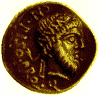
 The Seven Kings
The early history of Rome has always been an interesting mixture of heroic
legend and fact. According to legend, Rome was founded in 753 BC. Romulus was Rome's first king and after him there were 6 more kings. The period
traditionally lasted for 244 years (753-509 BC) and is known about through the
historian Livy who compiled his Great History of Rome in a single narrative during the rule
of Augustus, which indicates that he ascertained his information through
various myths and legends. (see Rome's Early Kings)
The Seven Kings
The early history of Rome has always been an interesting mixture of heroic
legend and fact. According to legend, Rome was founded in 753 BC. Romulus was Rome's first king and after him there were 6 more kings. The period
traditionally lasted for 244 years (753-509 BC) and is known about through the
historian Livy who compiled his Great History of Rome in a single narrative during the rule
of Augustus, which indicates that he ascertained his information through
various myths and legends. (see Rome's Early Kings)
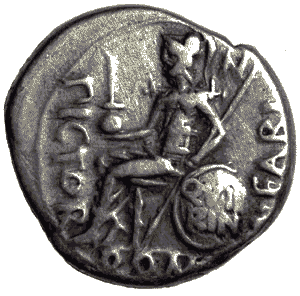
 Livy records that the kings were vitally important in the early growth of the
state. He said that the people at this time were, "a rabble of vagrants, mostly runaways and refugees, unrestrained by the power
of the throne, would no doubt have set sail on the stormy sea of democratic
politics." He mainly tells the story of them groping their way to political maturity when
writing of the seven kings. Their names were (click on each name):
Romulus
Numa Pompilius
Tullus Hostilius
Ancus Martius
Tarquinius Priscus
Servius Tullus
Tarquinius Superbus
(note: If you go to Rome today you can see parts of the Servian Wall which was once believed to have been built by Servius Tullius).
Romulus was known as a warrior-king and the great builder of Rome's first army
and of her first government.
Numa Pompilius, Rome's second king, brought a new kind of peace to the land and founded the
Roman religion.
The kings had special advisors who were known as the "Senate" (Latin for "old
men"). They were a council of elders from Rome's most prominent families. The
citizens would assemble and vote on whatever decisions were made by the king and
the "Senate."
Their religion greatly affected their decisions. In fact the king was also a
chief priest to the gods and he chose more priests from among the Senate. They would gather together and perform religious ceremonies and they would
also interpret whatever omens had been given.
Around 500 B.C., the Etruscan tyranny provoked these Latin peoples to active opposition and then a revolt,
the Etruscan king and his followers were driven into exile. Thus, there was
ushered in a new era of Roman history.
Click here to read some quotes by Livy regarding each king:
Livy About Rome's Early Kings
Livy records that the kings were vitally important in the early growth of the
state. He said that the people at this time were, "a rabble of vagrants, mostly runaways and refugees, unrestrained by the power
of the throne, would no doubt have set sail on the stormy sea of democratic
politics." He mainly tells the story of them groping their way to political maturity when
writing of the seven kings. Their names were (click on each name):
Romulus
Numa Pompilius
Tullus Hostilius
Ancus Martius
Tarquinius Priscus
Servius Tullus
Tarquinius Superbus
(note: If you go to Rome today you can see parts of the Servian Wall which was once believed to have been built by Servius Tullius).
Romulus was known as a warrior-king and the great builder of Rome's first army
and of her first government.
Numa Pompilius, Rome's second king, brought a new kind of peace to the land and founded the
Roman religion.
The kings had special advisors who were known as the "Senate" (Latin for "old
men"). They were a council of elders from Rome's most prominent families. The
citizens would assemble and vote on whatever decisions were made by the king and
the "Senate."
Their religion greatly affected their decisions. In fact the king was also a
chief priest to the gods and he chose more priests from among the Senate. They would gather together and perform religious ceremonies and they would
also interpret whatever omens had been given.
Around 500 B.C., the Etruscan tyranny provoked these Latin peoples to active opposition and then a revolt,
the Etruscan king and his followers were driven into exile. Thus, there was
ushered in a new era of Roman history.
Click here to read some quotes by Livy regarding each king:
Livy About Rome's Early Kings
Read The Bible
- 1599 Geneva Bible (GNV)
- 21st Century King James Version (KJ21)
- American Standard Version (ASV)
- Amplified Bible (AMP)
- Amplified Bible, Classic Edition (AMPC)
- Authorized (King James) Version (AKJV)
- BRG Bible (BRG)
- Christian Standard Bible (CSB)
- Common English Bible (CEB)
- Complete Jewish Bible (CJB)
- Contemporary English Version (CEV)
- Darby Translation (DARBY)
- Disciples’ Literal New Testament (DLNT)
- Douay-Rheims 1899 American Edition (DRA)
- Easy-to-Read Version (ERV)
- English Standard Version (ESV)
- English Standard Version Anglicised (ESVUK)
- Evangelical Heritage Version (EHV)
- Expanded Bible (EXB)
- GOD’S WORD Translation (GW)
- Good News Translation (GNT)
- Holman Christian Standard Bible (HCSB)
- International Children’s Bible (ICB)
- International Standard Version (ISV)
- J.B. Phillips New Testament (PHILLIPS)
- Jubilee Bible 2000 (JUB)
- King James Version (KJV)
- Lexham English Bible (LEB)
- Living Bible (TLB)
- Modern English Version (MEV)
- Mounce Reverse Interlinear New Testament (MOUNCE)
- Names of God Bible (NOG)
- New American Bible (Revised Edition) (NABRE)
- New American Standard Bible (NASB)
- New American Standard Bible 1995 (NASB1995)
- New Catholic Bible (NCB)
- New Century Version (NCV)
- New English Translation (NET)
- New International Reader's Version (NIRV)
- New International Version - UK (NIVUK)
- New International Version (NIV)
- New King James Version (NKJV)
- New Life Version (NLV)
- New Living Translation (NLT)
- New Matthew Bible (NMB)
- New Revised Standard Version (NRSV)
- New Revised Standard Version Catholic Edition (NRSVCE)
- New Revised Standard Version, Anglicised (NRSVA)
- New Revised Standard Version, Anglicised Catholic Edition (NRSVACE)
- New Testament for Everyone (NTE)
- Orthodox Jewish Bible (OJB)
- Revised Geneva Translation (RGT)
- Revised Standard Version (RSV)
- Revised Standard Version Catholic Edition (RSVCE)
- The Message (MSG)
- The Voice (VOICE)
- Tree of Life Version (TLV)
- World English Bible (WEB)
- Worldwide English (New Testament) (WE)
- Wycliffe Bible (WYC)
- Young's Literal Translation (YLT)
Table of Contents
Main Menu
- Ancient Assyrian Social Structure
- Ancient Babylonia
- Ancient Canaan During the Time of Joshua
- Ancient History Timeline
- Ancient Oil Lamps
- Antonia Fortress
- Archaeology of Ancient Assyria
- Assyria and Bible Prophecy
- Augustus Caesar
- Background Bible Study
- Bible
- Biblical Geography
- Fallen Empires - Archaeological Discoveries and the Bible
- First Century Jerusalem
- Glossary of Latin Words
- Herod Agrippa I
- Herod Antipas
- Herod the Great
- Herod's Temple
- High Priest's in New Testament Times
- Jewish Literature in New Testament Times
- Library collection
- Map of David's Kingdom
- Map of the Divided Kingdom - Israel and Judah
- Map of the Ministry of Jesus
- Matthew Henry Bible Commentary
- Messianic Prophecy
- Nero Caesar Emperor
- Online Bible Maps
- Paul's First Missionary Journey
- Paul's Second Missionary Journey
- Paul's Third Missionary Journey
- Pontius Pilate
- Questions About the Ancient World
- Tabernacle of Ancient Israel
- Tax Collectors in New Testament Times
- The Babylonian Captivity
- The Black Obelisk of Shalmaneser
- The Books of the New Testament
- The Court of the Gentiles
- The Court of the Women in the Temple
- The Destruction of Israel
- The Fall of Judah with Map
- The History Of Rome
- The Incredible Bible
- The Jewish Calendar in Ancient Hebrew History
- The Life of Jesus in Chronological Order
- The Life of Jesus in Harmony
- The Names of God
- The New Testament
- The Old Testament
- The Passion of the Christ
- The Pharisees
- The Sacred Year of Israel in New Testament Times
- The Samaritans
- The Scribes
Ancient Questions
- Why Do the Huldah Gates Appear Different in Ancient Replicas and Modern Photos?
- What Is the Origin of the Japanese and Chinese Peoples? A Biblical Perspective
- How did the ancient Greeks and Romans practice medicine and treat illnesses?
- What were the major contributions of ancient Babylon to mathematics and astronomy?
- How did the ancient Persians create and administer their vast empire?
- What were the cultural and artistic achievements of ancient India, particularly during the Gupta Empire?
- How did ancient civilizations like the Incas and Aztecs build their remarkable cities and structures?
- What were the major trade routes and trading practices of the ancient world?
- What was the role of slavery in ancient societies like Rome and Greece?
- How did the ancient Mayans develop their sophisticated calendar system?
Bible Study Questions
- Why did Moses say bastards are condemned?
- Why Do Christians Celebrate Christmas?
- How Many Chapters Are There in the Bible?
- The Five Key Visions in the New Testament
- The 400-Year Prophecy: Unpacking Genesis 15 and the Journey of a People
- The Authorized (King James) Version (AKJV): Historical Significance, Translation Methodology, and Lasting Impact
- Exploring the English Standard Version (ESV): Its Aspects, Comparisons, Impact on Biblical Studies, and Church Use
- A Detailed Historical Analysis of Language Updates in the KJ21: Comparison with Other Versions
- A Detailed Historical Analysis of the American Standard Version (ASV): Comparison to the King James Version, Influence on Later Translations, and Evaluation of Strengths and Weaknesses
- A Detailed Historical Analysis of Amplifications in the Amplified Bible (AMP) and Its Comparison to Other Bible Translations
About
Welcome to Free Bible: Unearthing the Past, Illuminating the Present! Step into a world where ancient history and biblical narratives intertwine, inviting you to explore the rich tapestry of human civilization.
Discover the captivating stories of forgotten empires, delve into the customs and cultures of our ancestors, and witness the remarkable findings unearthed by dedicated archaeologists.
Immerse yourself in a treasure trove of knowledge, where the past comes alive and illuminates our understanding of the present.
Join us on this extraordinary journey through time, where curiosity is rewarded and ancient mysteries await your exploration.
Recent posts
-

How to Detox Your Body Naturally with Ayurvedic Practices: A Comprehensive Guide
IntroductionWhen I first heard about how to detox your body naturally with ayurvedic practices, I was intrigued but also a bit skeptical. I stumbled u... -

Why the AI Subscription Model Is Broken (And What Comes Next)
There's a pricing model quietly draining the budgets of every serious AI user, and almost nobody is talking about it directly.It goes like this: a new... -
What Mistakes Do People Make Before Meeting with a Mobile Document Specialist?
In Los Angeles, notary public services (RON performed by licensed Notary Public in Florida) are in high demand, every day, many people turn to profess... -

Crypto Market Forecasting: How Data-Driven Predictions Are Changing Digital Asset Investing
The cryptocurrency market has entered a new stage of development. While early investors often relied on speculation and short-term price movements, to... -

From Ancient Wells to Modern Kitchens: The Timeless Value of Stewardship and Reliable Appliance Care
A Legacy of CareThe well was not just a place for water in the ancient world, it was the life of the community, a symbol of life, and a reflection of ...