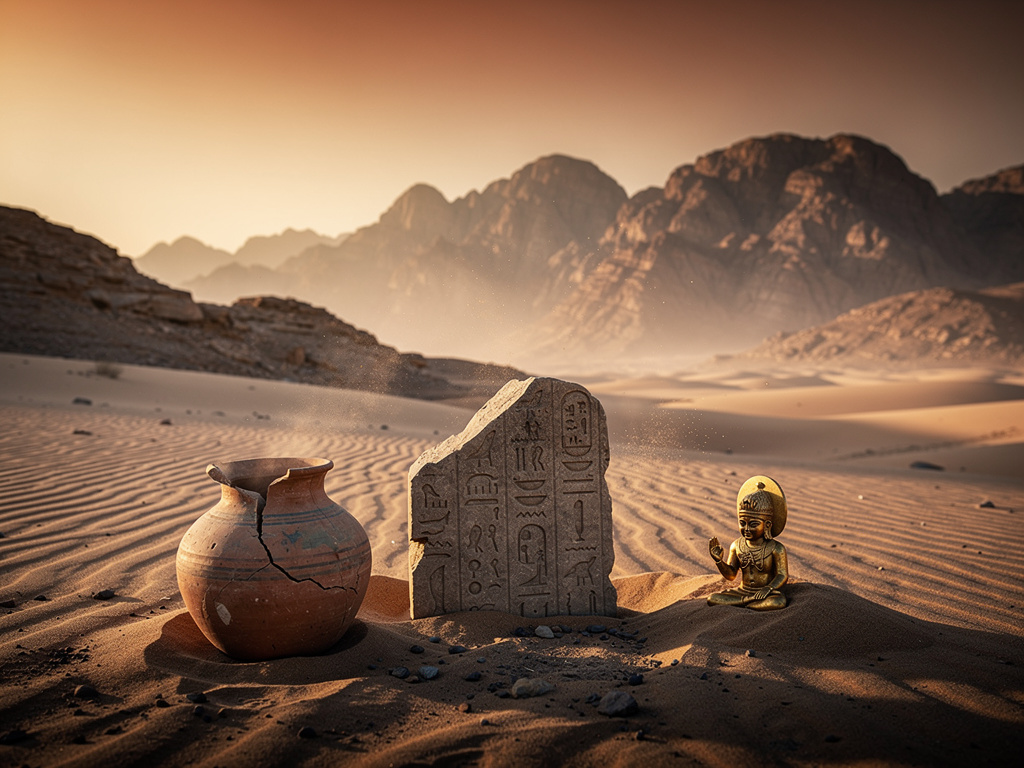
A Geographic Riddle in the Exodus Narrative
The story of the Exodus is one of the most enduring and debated narratives in biblical history. While scholars have long focused on place names, wilderness geography, and the route taken by the Israelites, a lesser-known historical puzzle may offer fresh clues: Why did Ptolemy II Philadelphus travel south to recover Egypt's gods without war?
This question, raised by researcher Garry Matheny, challenges traditional interpretations of the Pithom Stela - an ancient Egyptian inscription describing Ptolemy II's expedition to a place called Prstt. Most scholars identify Prstt as Persia or Palestine, but both locations present geographic and historical inconsistencies. Matheny proposes an alternative: Prstt was not an empire or city, but the Wilderness of Sinai itself.
In this article, we explore Matheny's hypothesis, its linguistic and archaeological foundations, and its implications for understanding the Exodus route.
The Pithom Stela and Ptolemy II's Mysterious Expedition
What Does the Pithom Stela Say?
The Pithom Stela, discovered in 1883, records an expedition by Ptolemy II Philadelphus (283–246 BC). According to Line 11 of the stela:
"He went to the south, entered Prstt, found the gods of Egypt, all of them, and returned them to Egypt."
Notably, the text mentions no war, enemy, or battle - only a peaceful recovery of divine artifacts.
The Geographic Problem
- Persia is east of Egypt, not south.
- Palestine is north of Egypt, not south.
- Neither location aligns with the stela's emphasis on a southern direction.
- No external records confirm a military campaign to Persia or Palestine during Ptolemy II's reign.
A Clue in the Desert: Ptolemy II's Inscription at Jebel Gharib
Archaeologists have found Greek inscriptions bearing Ptolemy II's name near Jebel Gharib, in the southern Eastern Desert - an area rarely discussed in Sinai research. This discovery suggests Ptolemy II ventured deep into the desert, far from Persia or Palestine.
Question: If Prstt was neither Persia nor Palestine, where was it?
Prstt as the Wilderness of Sinai: A Linguistic and Geographic Case
1. The Meaning of "Sinai" and "Sin"
- The Hebrew word for Sinai (סִינַי, sînay) is often translated as "thorny," but Gesenius' Lexicon suggests it means "clayey" or "miry."
- The Wilderness of Sin (Exodus 16:1) and the Wilderness of Sinai are closely linked in Hebrew:
- Sin (Ciyn) = Clay
- Sinai (Ciynay) = Clayey
- The Arabic name for Pelusium, a city near the Sinai Peninsula, is Teen (clay). Some maps also use Teeney, meaning "clayey."
- The Greek word for clay, pēlos (πηλός), is the root of Pelusium, a city whose name means "muddy" or "clayey."
2. Prstt → Pls → Pēlos (Clay)
- Egyptian hieroglyphs lacked the letter "L", so "r" was often substituted.
- Prstt could become Pls (replacing r with l and dropping the double t), which in Greek would be pēlos (clay).
- Conclusion: Prstt may refer to a clay-rich desert region - the Wilderness of Sinai.
3. The Determinative for Prstt
- The hieroglyphic determinative for Prstt denotes either a country or a desert.
- Wady Teeneh, marked on 19th-century maps, aligns with the Wilderness of Sinai - a clayey desert near Jebel Gharib.
Implication: Ptolemy II's expedition to Prstt (Pēlos/Clayey Desert) matches the Wilderness of Sinai's description.
Why Would Egypt's Gods Be in the Wilderness of Sinai?
1. The Israelites' Abandoned Idols
- Exodus 12:35–36 states the Israelites took Egyptian gold, silver, and clothing - possibly including cult objects.
- Exodus 33:4–6 describes the Israelites removing their ornaments at Mount Horeb (Sinai) after the golden calf incident.
- Genesis 35:2–4 records Jacob burying foreign gods before worshipping at Bethel. Similarly, the Israelites may have buried Egyptian idols at Sinai.
2. Targum Jonathan's Insight (3rd Century AD)
- The Targum Jonathan (an Aramaic translation of the Torah) claims Moses hid the ornaments in the Tabernacle (Exodus 33).
- If these ornaments included Egyptian cult objects, they could have been buried near Sinai, explaining Ptolemy II's peaceful recovery.
3. No War Needed
- If the gods were abandoned rather than stolen, Ptolemy II could retrieve them without conflict.
- This aligns with the Pithom Stela's description of a recovery, not a conquest.
Supporting Evidence: Ptolemy II's Southern Expeditions
1. The "Entrance of the South"
- The Pithom Stela places Prstt at the "entrance of the South."
- Diodorus Siculus (1st century BC) records Ptolemy II's travels to Ethiopia (south of Egypt).
- Ptolemy II's inscription at Jebel Gharib confirms his presence in the southern Eastern Desert.
2. Where Else Could Prstt Be?
- If Prstt was not Sinai, where is the record of Ptolemy II's expedition?
- No Egyptian texts describe a campaign to Persia or Palestine during his reign.
Challenges and Counterarguments
1. Alternative Interpretations of Prstt
- Some scholars argue Prstt = Persia, despite the directional mismatch.
- Others suggest Prstt = Philistia (Palestine), but this also conflicts with the southern route.
2. The Absence of Sinai in Ptolemaic Records
- Why don't other texts mention Sinai as Prstt?
- Possible explanation: The Wilderness of Sinai was a remote, uninhabited region, rarely documented in official records.
3. The Double "T" in Prstt
- The double "t" in Prstt is unusual, but Egyptian orthography was flexible.
- The simplification to "Pls" (clay) is linguistically plausible.
A New Perspective on the Exodus Route
Garry Matheny's hypothesis offers a compelling alternative to traditional views of Prstt. By linking linguistic, geographic, and archaeological evidence, he suggests:
- Prstt = Wilderness of Sinai (Pēlos/Clayey Desert)
- Ptolemy II recovered abandoned Egyptian idols - not conquered treasures.
- Jebel Gharib's inscription supports a southern expedition, not a northern or eastern one.
Implications for Exodus Research
- The Wilderness of Sinai may have been a repository of Egyptian cult objects after the Exodus.
- The Pithom Stela could provide new clues for locating Mount Sinai.
- Future research should explore Ptolemaic-era inscriptions in the Eastern Desert.
Further Reading and Resources
- The Quest for Mount Sinai by Garry Matheny (Free PDF)
- Easton's Bible Dictionary (Entry on Pelusium)
- Gesenius' Hebrew-Chaldee Lexicon (Entries on Sin/Sinai)
Join the Discussion
What do you think? Could Prstt really be the Wilderness of Sinai?
Route Of The Exodus Exodus From Egypt Ancient Egypt Biblical Archaeology Exodus Story Exodus Journey Ancient Egyptian Biblical Exodus Exodus route Ptolemy II Philadelphus Pithom Stela Wilderness of Sinai Mount Sinai location Ancient Egypt gods Biblical geography Prstt meaning Jebel Gharib inscription