Ancient Ox Carts
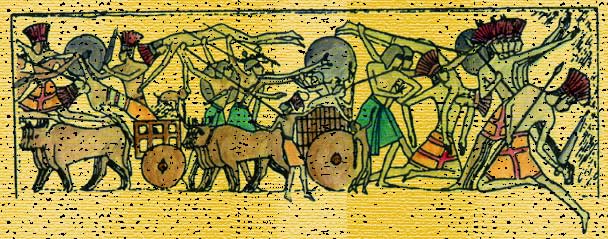
Illustration of Ancient
Philistine Ox Carts
The ox carts of the Philistines usually carried women and children being drawn by many oxen, usually four. They were shaped in a square and were made of wood, though sometimes they were made of woven materials. The wheels were made of wood. In the well-known story of the return of the ark of the covenant (1 Samuel 6:7), the Golden Ark was placed on a wooden cart and sent back to Israel.
2 Samuel 6:3 - And they set the ark of God upon a new cart, and brought it out of the house of Abinadab that [was] in Gibeah: and Uzzah and Ahio, the sons of Abinadab, drave the new cart.
Oxen and bullocks were perhaps a larger proportion of the wealth of Oriental peoples in olden times than now. The apostle asks: "Doth God take care for oxen?" "Thou shalt not muzzle the ox when he treadeth out the com." ^ The Mosaic law also provided that on the Sabbath "Thine ox and thine ass may rest." ^ The prophet Elisha "was ploviing with twelve yoke of oxen before him, and he with the t^'elfth," when Elijah met him and called him to the prophetical work.^ The purchase of oxen was made an excuse for not responding to a social inxitation: "I have bought five yoke of oxen, and I go to prove them,"* The cows and the calves were trained to the yoke in early times. Thus, when the lords of the Philistines wanted to send back the ark, they said; "Make a new cart, and take two milch kine, on which there hath come no yoke, and tie the kine to the cart, and bring their calves home from them: and take the ark of the Lord and lay it upon the cart." And the prophet calls Ephraim "An heifer that is taught, and loveth to tread out the com." [Orientalisms in Bible Lands]
Cart in
Smith's Bible Dictionary - Ge 45:19,27; Nu 7:3,7,8 a vehicle
drawn by cattle, 2Sa 6:6 to be distinguished from the chariot drawn
by horses. Carts and wagons were either open or covered, Nu 7:3 and
were used for conveyance of person, Ge 45:19 burdens, 1Sa 6:7,8 or
produce. Am 2:13 The only cart used in western Asia has two wheels
of solid wood.
/smiths/C/Cart/
Cart in
Easton's Bible Dictionary - A vehicle moving on wheels, and
usually drawn by oxen (2 Sam. 6:3). The Hebrew word thus rendered,
_'agalah_ (1 Sam. 6:7, 8), is also rendered "wagon" (Gen. 45:19). It
is used also to denote a war-chariot (Ps. 46:9). Carts were used for
the removal of the ark and its sacred utensils (Num. 7:3, 6). After
retaining the ark amongst them for seven months, the Philistines
sent it back to the Israelites. On this occasion they set it in a
new cart, probably a rude construction, with solid wooden wheels
like that still used in Western Asia, which was drawn by two milch
cows, which conveyed it straight to Beth-shemesh. A "cart rope," for
the purpose of fastening loads on carts, is used (Isa. 5:18) as a
symbol of the power of sinful pleasures or habits over him who
indulges them. (See CORD �T0000898.) In Syria and Israel
wheel-carriages for any other purpose than the conveyance of
agricultural produce are almost unknown.
/eastons/C/Cart/
Cart in the
Bible Encyclopedia - ISBE: kart (`aghalah): The Hebrew word
has been translated in some passages "cart," and in others "wagon."
In one verse only has it been translated "chariot." The context of
the various passages indicates that a distinction was made between
vehicles which were used for carrying baggage or produce and those
used for carrying riders (chariots), although in their primitive
form of construction they were much the same (compare English "cart"
and "carriage"). Carts, like "chariots" (which see), were of
Assyrian origin. They were early carried to Egypt where the flat
nature of the country readily led to their adoption. From Egypt they
gradually found their way among the people of the Palestinian
plains. In the hills of Judea and Central Israel, except where
highways were built (1 Sam 6:12), the nature of the country
prevented the use of wheeled vehicles. 1 Sam 6:7,8,10,11,14 show
that the people of the plains used carts. The men of Kiriath-jearim
found it easier to carry the ark (1 Sam 7:1). Their attempt to use a
cart later (2 Sam 6:3,1; 1 Ch 13:7) proved disastrous and they
abandoned it for a safer way (2 Sam 6:13). That carts were used at a
very early date is indicated by Nu 7:3,7,8. That these vehicles were
not the common mode of conveyance in Israel is shown in Gen 45.
Pharaoh commanded that Joseph's brethren should return to their
father with their beasts of burden (45:21) and take with them
Egyptian wagons (45:19,21; 46:6) for bringing back their father and
their families. The very unusual sight of the wagons was proof to
Jacob of Joseph's existence (45:27). Bible descriptions and ancient
Babylonian and Egyptian pictures indicate that the cart was usually
two-wheeled and drawn by two oxen. With the Arabian conquests and
subsequent ruin of the roads wheeled vehicles disappeared from Syria
and Israel. History is again repeating itself. The Circassians, whom
the Turkish government has settled near Caesarea, Jerash (Gerasa)
and Amman (Philadelphia), have introduced a crude cart which must be
similar to that used in Old Testament times. The two wheels are of
solid wood. A straight shaft is joined to the wooden axle, and to
this a yoke of oxen is attached. On the Philistian plains may be
seen carts of present-day Egyptian origin but of a pattern many
centuries old. With the establishment of government roads during the
last 50 years, European vehicles of all descriptions are fast coming
into the country.
One figurative reference is made to the cart (Isa 5:18), but its
meaning is obscure.
/isbe/C/CART/
In Egypt, the use of the ilail is unknown. To separate the grain from the straw, the inhabitants prepare, with a mixture of earth, &c., spacious floors, well beat, and very clean. The rice is spread thereon, in thick layers. They have then a sort of cart, formed of two pieces of wood joined together by two cross-pieces. It is almost in the shape of sledges which serve for the conveyance of burdens in the streets of our cities. Between the longer sides of this sledge are fixed, transversely, three rows of small wheels, made of solid iron,^ and narrowed off toward their circumference. On the forepart is a wide and high seat, upon which a man sits, driving two oxen harnessed to the machine. The whole moves on slowly, and always in a circular direction, over every part of the heap of rice, until there remains no more grain in the straw. When it is thus beat, it is spread in the air to be dried. Several men walk abreast, to turn it over, each of whom, with his foot, makes a furrow in the layer of grain ; so that in a few moments the whole mass is moved, and that part which was underneath is again exposed to the air. � Sonnini : Harjmr's Observations^ vol. iv., pp. 134, 135.
 The Bible mentions a lot concerning
"Carts"
The Bible mentions a lot concerning
"Carts"
Isaiah
28:27 - For the fitches are not threshed with a threshing
instrument, neither is a cart wheel turned about upon
the cummin; but the fitches are beaten out with a staff, and the
cummin with a rod.
Amos 2:13
- Behold, I am pressed under you, as a cart is pressed
[that is] full of sheaves.
1 Samuel
6:8 - And take the ark of the LORD, and lay it upon the
cart; and put the jewels of gold, which ye return him
[for] a trespass offering, in a coffer by the side thereof; and send
it away, that it may go.
Isaiah
28:28 - Bread [corn] is bruised; because he will not ever be
threshing it, nor break [it with] the wheel of his cart,
nor bruise it [with] his horsemen.
1 Samuel
6:11 - And they laid the ark of the LORD upon the cart,
and the coffer with the mice of gold and the images of their emerods.
1 Samuel
6:10 - And the men did so; and took two milch kine, and tied
them to the cart, and shut up their calves at home:
Isaiah 5:18
- Woe unto them that draw iniquity with cords of vanity, and sin as
it were with a cart rope:
1 Samuel
6:7 - Now therefore make a new cart, and take
two milch kine, on which there hath come no yoke, and tie the kine
to the cart, and bring their calves home from them:
2 Samuel
6:3 - And they set the ark of God upon a new cart,
and brought it out of the house of Abinadab that [was] in Gibeah:
and Uzzah and Ahio, the sons of Abinadab, drave the new cart.
1 Samuel
6:14 - And the cart came into the field of
Joshua, a Bethshemite, and stood there, where [there was] a great
stone: and they clave the wood of the cart, and
offered the kine a burnt offering unto the LORD.
1
Chronicles 13:7 - And they carried the ark of God in a new
cart out of the house of Abinadab: and Uzza and Ahio
drave the cart.
Read The Bible
- 1599 Geneva Bible (GNV)
- 21st Century King James Version (KJ21)
- American Standard Version (ASV)
- Amplified Bible (AMP)
- Amplified Bible, Classic Edition (AMPC)
- Authorized (King James) Version (AKJV)
- BRG Bible (BRG)
- Christian Standard Bible (CSB)
- Common English Bible (CEB)
- Complete Jewish Bible (CJB)
- Contemporary English Version (CEV)
- Darby Translation (DARBY)
- Disciples’ Literal New Testament (DLNT)
- Douay-Rheims 1899 American Edition (DRA)
- Easy-to-Read Version (ERV)
- English Standard Version (ESV)
- English Standard Version Anglicised (ESVUK)
- Evangelical Heritage Version (EHV)
- Expanded Bible (EXB)
- GOD’S WORD Translation (GW)
- Good News Translation (GNT)
- Holman Christian Standard Bible (HCSB)
- International Children’s Bible (ICB)
- International Standard Version (ISV)
- J.B. Phillips New Testament (PHILLIPS)
- Jubilee Bible 2000 (JUB)
- King James Version (KJV)
- Lexham English Bible (LEB)
- Living Bible (TLB)
- Modern English Version (MEV)
- Mounce Reverse Interlinear New Testament (MOUNCE)
- Names of God Bible (NOG)
- New American Bible (Revised Edition) (NABRE)
- New American Standard Bible (NASB)
- New American Standard Bible 1995 (NASB1995)
- New Catholic Bible (NCB)
- New Century Version (NCV)
- New English Translation (NET)
- New International Reader's Version (NIRV)
- New International Version - UK (NIVUK)
- New International Version (NIV)
- New King James Version (NKJV)
- New Life Version (NLV)
- New Living Translation (NLT)
- New Matthew Bible (NMB)
- New Revised Standard Version (NRSV)
- New Revised Standard Version Catholic Edition (NRSVCE)
- New Revised Standard Version, Anglicised (NRSVA)
- New Revised Standard Version, Anglicised Catholic Edition (NRSVACE)
- New Testament for Everyone (NTE)
- Orthodox Jewish Bible (OJB)
- Revised Geneva Translation (RGT)
- Revised Standard Version (RSV)
- Revised Standard Version Catholic Edition (RSVCE)
- The Message (MSG)
- The Voice (VOICE)
- Tree of Life Version (TLV)
- World English Bible (WEB)
- Worldwide English (New Testament) (WE)
- Wycliffe Bible (WYC)
- Young's Literal Translation (YLT)
Table of Contents
Main Menu
- Ancient Assyrian Social Structure
- Ancient Babylonia
- Ancient Canaan During the Time of Joshua
- Ancient History Timeline
- Ancient Oil Lamps
- Antonia Fortress
- Archaeology of Ancient Assyria
- Assyria and Bible Prophecy
- Augustus Caesar
- Background Bible Study
- Bible
- Biblical Geography
- Fallen Empires - Archaeological Discoveries and the Bible
- First Century Jerusalem
- Glossary of Latin Words
- Herod Agrippa I
- Herod Antipas
- Herod the Great
- Herod's Temple
- High Priest's in New Testament Times
- Jewish Literature in New Testament Times
- Library collection
- Map of David's Kingdom
- Map of the Divided Kingdom - Israel and Judah
- Map of the Ministry of Jesus
- Matthew Henry Bible Commentary
- Messianic Prophecy
- Nero Caesar Emperor
- Online Bible Maps
- Paul's First Missionary Journey
- Paul's Second Missionary Journey
- Paul's Third Missionary Journey
- Pontius Pilate
- Questions About the Ancient World
- Tabernacle of Ancient Israel
- Tax Collectors in New Testament Times
- The Babylonian Captivity
- The Black Obelisk of Shalmaneser
- The Books of the New Testament
- The Court of the Gentiles
- The Court of the Women in the Temple
- The Destruction of Israel
- The Fall of Judah with Map
- The History Of Rome
- The Incredible Bible
- The Jewish Calendar in Ancient Hebrew History
- The Life of Jesus in Chronological Order
- The Life of Jesus in Harmony
- The Names of God
- The New Testament
- The Old Testament
- The Passion of the Christ
- The Pharisees
- The Sacred Year of Israel in New Testament Times
- The Samaritans
- The Scribes
Ancient Questions
- Why Do the Huldah Gates Appear Different in Ancient Replicas and Modern Photos?
- What Is the Origin of the Japanese and Chinese Peoples? A Biblical Perspective
- How did the ancient Greeks and Romans practice medicine and treat illnesses?
- What were the major contributions of ancient Babylon to mathematics and astronomy?
- How did the ancient Persians create and administer their vast empire?
- What were the cultural and artistic achievements of ancient India, particularly during the Gupta Empire?
- How did ancient civilizations like the Incas and Aztecs build their remarkable cities and structures?
- What were the major trade routes and trading practices of the ancient world?
- What was the role of slavery in ancient societies like Rome and Greece?
- How did the ancient Mayans develop their sophisticated calendar system?
Bible Study Questions
- Why did Moses say bastards are condemned?
- Why Do Christians Celebrate Christmas?
- How Many Chapters Are There in the Bible?
- The Five Key Visions in the New Testament
- The 400-Year Prophecy: Unpacking Genesis 15 and the Journey of a People
- The Authorized (King James) Version (AKJV): Historical Significance, Translation Methodology, and Lasting Impact
- Exploring the English Standard Version (ESV): Its Aspects, Comparisons, Impact on Biblical Studies, and Church Use
- A Detailed Historical Analysis of Language Updates in the KJ21: Comparison with Other Versions
- A Detailed Historical Analysis of the American Standard Version (ASV): Comparison to the King James Version, Influence on Later Translations, and Evaluation of Strengths and Weaknesses
- A Detailed Historical Analysis of Amplifications in the Amplified Bible (AMP) and Its Comparison to Other Bible Translations
About
Welcome to Free Bible: Unearthing the Past, Illuminating the Present! Step into a world where ancient history and biblical narratives intertwine, inviting you to explore the rich tapestry of human civilization.
Discover the captivating stories of forgotten empires, delve into the customs and cultures of our ancestors, and witness the remarkable findings unearthed by dedicated archaeologists.
Immerse yourself in a treasure trove of knowledge, where the past comes alive and illuminates our understanding of the present.
Join us on this extraordinary journey through time, where curiosity is rewarded and ancient mysteries await your exploration.
Recent posts
-

Why the AI Subscription Model Is Broken (And What Comes Next)
There's a pricing model quietly draining the budgets of every serious AI user, and almost nobody is talking about it directly.It goes like this: a new... -

What Mistakes Do People Make Before Meeting with a Mobile Document Specialist?
In Los Angeles, notary public services (RON performed by licensed Notary Public in Florida) are in high demand, every day, many people turn to profess... -

Crypto Market Forecasting: How Data-Driven Predictions Are Changing Digital Asset Investing
The cryptocurrency market has entered a new stage of development. While early investors often relied on speculation and short-term price movements, to... -

From Ancient Wells to Modern Kitchens: The Timeless Value of Stewardship and Reliable Appliance Care
A Legacy of CareThe well was not just a place for water in the ancient world, it was the life of the community, a symbol of life, and a reflection of ... -

Walk in Faith and Health: Discover Qozgal, the Free Step Challenge App Inspired by Ancient Journeys
Walking was an important part of people's lives in both ancient times and in the Bible, as the Israelites walked through the wilderness for 40 years o...