Was the Caspian Sea Mentioned in the Bible?

Was the Caspian Sea Mentioned in the Bible?... hero image

The Caspian Sea was not mentioned in the Bible. In Old Testament times the Caspian Sea was mainly just a large body of water marking the northeast corner of what we recognize as the world of the Old Testament. One interesting fact is that the Caspian Sea is the largest body of water in the world completely encompassed by land. Many rivers flow into it but there are no rivers flowing out of it, and only by evaporation does the water leave the Sea. Some scholars trace the garden of Eden to a close proximity of the Caspian Sea, and scholars also mark a nearby area as the place where Noah’s Ark came to rest after the Flood.

Source:
The Old Testament World


Related Articles:

Why were the Seven Hills of Rome Significant? post related image

Why were the Seven Hills of Rome Significant?

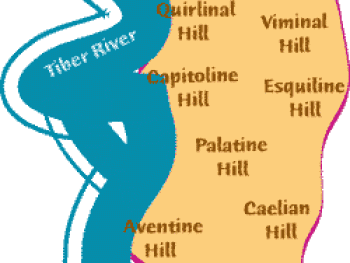
The seven hills of Rome were very noticeable in the landscape of the city of Rome. The hills were no higher than 60 yards, but they had steep slopes that rose above the flat marshland. Several small streams flowed between the seven hills. The names o...

How many were in Jerusalem for the Passover of Jesus? post related image

How many were in Jerusalem for the Passover of Jesus?

The main sources available estimate that the population of those living in Jerusalem during the time of Jesus was probably around 80,000 to 100,000 citizens. But during the Passover hundreds of thousands of Jews from the Diaspora would pour into Jeru...

What is the Black Obelisk? post related image

What is the Black Obelisk?

In 1846 an English traveler and artist named Austen Henry Layard was digging around the ruins of ancient Nimrud (known as Calah) in northern Iraq. He discovered something amazing, a black limestone obelisk now referred to as “The Black Obelisk of S...

How did Topography influence the people of Ancient Greece?

The people of ancient Greece developed unique characteristics because of the topography of their country. The coastline curved inward very peculiarly, causing the bays to become very prominent, and stretching far out into the Mediterranean Sea. This ...

Why was Hadrian’s Arch Erected in Jordan?

Hadrian's Arch, also known as the Arch of Hadrian or the Triumphal Arch, is an ancient Roman monument located in Jerash, Jordan. It was erected during the reign of the Roman Emperor Hadrian in the 2nd century CE. While the Bible does not specifically...

What is the Bronze Bust of Augustus? post related image

What is the Bronze Bust of Augustus?

This bust was discovered by archaeologists at Meroe (Modern Sudan) and is currently in the British Museum. It depicts the face of the Roman Emperor Augustus who ordered the census just before the birth of Jesus. This brought the parents of Jesus (Jos...

Was Zeus the Same to the Romans as Jesus to the Christians? post related image

Was Zeus the Same to the Romans as Jesus to the Christians?

In Christianity, Jesus is the One true God who came to earth clothed in human flesh. In Greek and Roman mythology Zeus (Jupiter) was a celestial deity, and one of many gods. Zeus was the chief of the gods of Olympus, and he was the son of Saturn and ...

What was the Wilderness of Judea?

The Wilderness of Judea, mentioned in the Bible, refers to a geographical region located east of Jerusalem and extending toward the Dead Sea. It is characterized by its rugged terrain, barren landscapes, and limited vegetation, making it a challengin...

How were the people of Ancient Greece influenced by Topography? post related image

How were the people of Ancient Greece influenced by Topography?

The people of ancient Greece developed unique characteristics because of the topography of their country. The coastline curved inward very peculiarly, causing the bays to become very prominent, and stretching far out into the Mediterranean Sea. This ...

What was an Alabaster Jar?

In the Bible, an alabaster jar refers to a type of container made from alabaster stone. Alabaster is a soft, white or translucent mineral often used in ancient times for crafting vessels or containers for various purposes. One notable mention of an a...

Where was the land of Assyria located? post related image

Where was the land of Assyria located?

The land of ancient Assyria was located in the far north of the Tigris river near modern Mosul. In their earliest history Assyria was a small territory on the left bank of the northern Tigris River. Over time their borders extended to the area be...

Why is the Arch of Titus Relief so Significant? post related image

Why is the Arch of Titus Relief so Significant?

In 70 AD the Romans laid siege to Jerusalem and utterly destroyed and buried one of the greatest cities of the ancient world. This was all predicted by Jesus in the New Testament approximately 40 years prior. Source: Relief from the Arch of Titus ...

How did ancient Egyptians mummify their dead?

Ancient Egyptians had a complex and elaborate process of mummification to preserve the bodies of the deceased for the afterlife. The process involved several steps: Removal of organs: The embalmers would first remove the internal organs, except for t...

Do any Archaeological Discoveries Mention King David?

Yes, archaeological discoveries have provided evidence that supports the existence of King David, a significant figure in biblical history. While there are no direct inscriptions or artifacts that mention King David by name, several discoveries have ...

What was a Roman Legion? post related image

What was a Roman Legion?

Augustus, the first emperor of Rome had in his empire 25 legions of approximately 6,000 soldiers each. A legion was formed of 10 Cohorts (540 men in each Cohort). Each Cohort was subdivided into 6 Centuries (90 men formed a Century), and each legion ...

Why Did the Goddess Diana have so many Breasts? post related image

Why Did the Goddess Diana have so many Breasts?

In the Temple of Artemis also referred to as Diana the statue of the Roman goddess was depicted as covered entirely with breasts. This is because Diana was the goddess of fertility, and the multi-breasts were denoting fertility, nourishing the living...

What Historical Sources do we have for the Life of Alexander the Great?

The five primary sources we have for the events in the life of Alexander are Diodorus Siculus, Quintus Curtius Rufus, Plutarch, Lucius Flavius Arrianus, and the Alexander Romance. “For I myself believe that there was at that time no race of mankind...

Why Do the Huldah Gates Appear Different in Ancient Replicas and Modern Photos? post related image

Why Do the Huldah Gates Appear Different in Ancient Replicas and Modern Photos?

The Huldah Gates, located on the southern wall of the Temple Mount in Jerusalem, are a significant archaeological and historical feature. These gates served as entrances and exits for worshippers ascending to the Temple during the Second Temple perio...


Read The Bible

About

Welcome to Free Bible: Unearthing the Past, Illuminating the Present! Step into a world where ancient history and biblical narratives intertwine, inviting you to explore the rich tapestry of human civilization.

Discover the captivating stories of forgotten empires, delve into the customs and cultures of our ancestors, and witness the remarkable findings unearthed by dedicated archaeologists.

Immerse yourself in a treasure trove of knowledge, where the past comes alive and illuminates our understanding of the present.

Join us on this extraordinary journey through time, where curiosity is rewarded and ancient mysteries await your exploration.

Recent posts